Finally, somebody has the right idea, and the balls to follow through with it. Texas Governor Rick Perry has issued an executive order mandating the use of the new human papillomavirus (HPV) vaccine for all 6th grade girls in the state of Texas. In doing so, he sidesteps the conservative Texas legislature (who the late, great Molly Ivins called "The Ledge") and enters it directly into law.
Of course, this has conservatives howling about how the vaccine promotes premarital sex and also interfering with how they desire to raise their children.
Um... excuse me? This is a great breakthrough here. In a very rare case, we are able to provide a vaccine that can stop a form of cancer. CANCER. One of the top killers in this country right now. And we can stop it. This is the same as vaccinating against tetanus, polio, or smallpox. It has nothing to do with sex, and it certainly does not promote it to young girls. It is about saving lives.
And as far as legislating how parents raise their kids, the same vaccine argument holds true. It is standard that children get a battery of disease-preventing innoculations. Hep B is required for many college entrances. Why should this one be any different?
It galls me when these high-minded people are putting their own children at risk to cancer. Thank you Perry for taking the insightful step and bypassing all the hot air that blows around this subject.
Friday, February 02, 2007


Wednesday, January 24, 2007
New Year, Same Words
Let's take a look at the President's speech last night, shall we?
"Extending hope and opportunity depends on a stable supply of energy that keeps America's economy running and America's environment clean. For too long our nation has been dependent on foreign oil. And this dependence leaves us more vulnerable to hostile regimes, and to terrorists -- who could cause huge disruptions of oil shipments, and raise the price of oil, and do great harm to our economy.
 It's in our vital interest to diversify America's energy supply -- the way forward is through technology. We must continue changing the way America generates electric power, by even greater use of clean coal technology, solar and wind energy, and clean, safe nuclear power. (Applause.) We need to press on with battery research for plug-in and hybrid vehicles, and expand the use of clean diesel vehicles and biodiesel fuel. (Applause.) We must continue investing in new methods of producing ethanol -- (applause) -- using everything from wood chips to grasses, to agricultural wastes.
We made a lot of progress, thanks to good policies here in Washington and the strong response of the market. And now even more dramatic advances are within reach. Tonight, I ask Congress to join me in pursuing a great goal. Let us build on the work we've done and reduce gasoline usage in the United States by 20 percent in the next 10 years. (Applause.) When we do that we will have cut our total imports by the equivalent of three-quarters of all the oil we now import from the Middle East.
To reach this goal, we must increase the supply of alternative fuels, by setting a mandatory fuels standard to require 35 billion gallons of renewable and alternative fuels in 2017 -- and that is nearly five times the current target. (Applause.) At the same time, we need to reform and modernize fuel economy standards for cars the way we did for light trucks -- and conserve up to 8.5 billion more gallons of gasoline by 2017."Laudable statements. Certainly noble causes, for the pursuit of a cleaner environment and an independent energy source."
But wait! What did our forward thinking President say last year?
"Keeping America competitive requires affordable energy. And here we have a serious problem: America is addicted to oil, which is often imported from unstable parts of the world. The best way to break this addiction is through technology. Since 2001, we have spent nearly $10 billion to develop cleaner, cheaper, and more reliable alternative energy sources -- and we are on the threshold of incredible advances.
So tonight, I announce the Advanced Energy Initiative -- a 22-percent increase in clean-energy research -- at the Department of Energy, to push for breakthroughs in two vital areas. To change how we power our homes and offices, we will invest more in zero-emission coal-fired plants, revolutionary solar and wind technologies, and clean, safe nuclear energy. (Applause.)
We must also change how we power our automobiles. We will increase our research in better batteries for hybrid and electric cars, and in pollution-free cars that run on hydrogen. We'll also fund additional research in cutting-edge methods of producing ethanol, not just from corn, but from wood chips and stalks, or switch grass. Our goal is to make this new kind of ethanol practical and competitive within six years. (Applause.)
Breakthroughs on this and other new technologies will help us reach another great goal: to replace more than 75 percent of our oil imports from the Middle East by 2025. (Applause.) By applying the talent and technology of America, this country can dramatically improve our environment, move beyond a petroleum-based economy, and make our dependence on Middle Eastern oil a thing of the past. (Applause.)"
It is good to pay lip service to these goals, and to mention them certainly brings about awareness, which can help jump start the whole process. But merely stating them year after year is not enough; the President needs to back up his words with powerful legislation, bringin oil and car companies to heel as he moves forward in strengthening fuel economy standards, dramatically increasing funding into new research, as well as bringing more incentives to the table for commercial and residential units to move with new alternative fuel options, such as solar, wind, water, or other methods. He would do well to look to California, for their Million Solar initiative, and the new restrictions placed on automobiles' emissions. Only by actions can the words he speak come true, so he doesn't need to repeat himself ad naseum.
"Extending hope and opportunity depends on a stable supply of energy that keeps America's economy running and America's environment clean. For too long our nation has been dependent on foreign oil. And this dependence leaves us more vulnerable to hostile regimes, and to terrorists -- who could cause huge disruptions of oil shipments, and raise the price of oil, and do great harm to our economy.
It's in our vital interest to diversify America's energy supply -- the way forward is through technology. We must continue changing the way America generates electric power, by even greater use of clean coal technology, solar and wind energy, and clean, safe nuclear power. (Applause.) We need to press on with battery research for plug-in and hybrid vehicles, and expand the use of clean diesel vehicles and biodiesel fuel. (Applause.) We must continue investing in new methods of producing ethanol -- (applause) -- using everything from wood chips to grasses, to agricultural wastes.We made a lot of progress, thanks to good policies here in Washington and the strong response of the market. And now even more dramatic advances are within reach. Tonight, I ask Congress to join me in pursuing a great goal. Let us build on the work we've done and reduce gasoline usage in the United States by 20 percent in the next 10 years. (Applause.) When we do that we will have cut our total imports by the equivalent of three-quarters of all the oil we now import from the Middle East.
To reach this goal, we must increase the supply of alternative fuels, by setting a mandatory fuels standard to require 35 billion gallons of renewable and alternative fuels in 2017 -- and that is nearly five times the current target. (Applause.) At the same time, we need to reform and modernize fuel economy standards for cars the way we did for light trucks -- and conserve up to 8.5 billion more gallons of gasoline by 2017."Laudable statements. Certainly noble causes, for the pursuit of a cleaner environment and an independent energy source."
But wait! What did our forward thinking President say last year?
"Keeping America competitive requires affordable energy. And here we have a serious problem: America is addicted to oil, which is often imported from unstable parts of the world. The best way to break this addiction is through technology. Since 2001, we have spent nearly $10 billion to develop cleaner, cheaper, and more reliable alternative energy sources -- and we are on the threshold of incredible advances.
So tonight, I announce the Advanced Energy Initiative -- a 22-percent increase in clean-energy research -- at the Department of Energy, to push for breakthroughs in two vital areas. To change how we power our homes and offices, we will invest more in zero-emission coal-fired plants, revolutionary solar and wind technologies, and clean, safe nuclear energy. (Applause.)
We must also change how we power our automobiles. We will increase our research in better batteries for hybrid and electric cars, and in pollution-free cars that run on hydrogen. We'll also fund additional research in cutting-edge methods of producing ethanol, not just from corn, but from wood chips and stalks, or switch grass. Our goal is to make this new kind of ethanol practical and competitive within six years. (Applause.)
Breakthroughs on this and other new technologies will help us reach another great goal: to replace more than 75 percent of our oil imports from the Middle East by 2025. (Applause.) By applying the talent and technology of America, this country can dramatically improve our environment, move beyond a petroleum-based economy, and make our dependence on Middle Eastern oil a thing of the past. (Applause.)"
It is good to pay lip service to these goals, and to mention them certainly brings about awareness, which can help jump start the whole process. But merely stating them year after year is not enough; the President needs to back up his words with powerful legislation, bringin oil and car companies to heel as he moves forward in strengthening fuel economy standards, dramatically increasing funding into new research, as well as bringing more incentives to the table for commercial and residential units to move with new alternative fuel options, such as solar, wind, water, or other methods. He would do well to look to California, for their Million Solar initiative, and the new restrictions placed on automobiles' emissions. Only by actions can the words he speak come true, so he doesn't need to repeat himself ad naseum.
Friday, January 19, 2007
Surging Stupidity
I do not usually post twice in one day, not even twice in one week, but this caught my attention and I had to dig into it. I have not been terribly vocal on this site about the war in Iraq; those of you who know me know of my opinions of it, and that is fine.
However, today we get a new chapter in the troop "surge" planned by POTUS Bush and his new Secretary of Defense pal Gates. General George Casey claims that "I think it's probably going to be the summer, late summer, before you get to the point where people in Baghdad feel safe in their neighborhoods." Overall, there is the belief that the "surge" troops could be home by summertime.
Ahem, excuse me? Did you say that these ~20,000 troops would be sticking around for only 5 or 6 months? And then magically everything winds up alright and they get to return to their homes? This smells similarly of former declarations of quick-fix, easy-winnable military operations. We're still in Afghanistan, we're still in Iraq, and I don't see those surging numbers coming home anytime soon. I hope they do, but I feel the administration has tried to give an artificial boost of hope into a situation where it would have been prudent to be pragmatic and realistic.
Please Protect Me Myspace!!
There never seems to be a lack of articles proudly announcing that we are the most uncommonsensical people ever. It staggers me sometimes how people manage to function on a day to day basis without major help. Then again, I read the "Caution: the beverage you're about to enjoy is hot" warning on my hot chocolate, and I begin to understand.
Today's consternation arrives in the form of a lawsuit. The obscenely popular myspace.com website is facing several lawsuits from parents of the site's users. They are alleging that the website is not adequately protecting their kids from online predators. Why do they make these stunning allegations? According to one report on time.com, "The lawyers who filed the latest lawsuits said the plaintiffs include a 15-year-old girl from Texas who was lured to a meeting, drugged and assaulted in 2006 by an adult MySpace user, who is currently serving a 10-year sentence in Texas after pleading guilty to sexual assault."
Now hold on a damn minute. I agree that the Internet can be a vulnerable place, and it certainly has its share of perverts cruising sites looking for teens to chat with, look at, and think hideous thoughts about (though, it sounds like Congress is that sort of place too). And there should be some modicum of protection afforded younger members of the Internet, as they can be more vulnerable to that sort of online harassment. But teens who met and were drugged and raped by people they found at myspace? We're not talking about 7-year-olds who don't know any better. If you're 15, you're in high school by that point, and have almost certainly come in contact with various forms of harassment and entreaties. What the hell were they thinking? Who in their right minds agrees to meet someone privately first off after an Internet conversation? Meet at a coffee shop, meet at a bookstore, meet at a mall. Don't meet privately. Hello, is there no remains of common sense?
And where in God's name were the parents during all this? I don't agree that parents should hover over their children's every move online, but some idle questions wouldn't hurt. And certainly if they were going to meet someone, questions should be posed to figure out who, when, where, and why.
I cannot imagine that the fault for this lies with the Internet company. Hemanshu Nigam, MySpace's chief security officer, said in a statement that Internet safety is a shared responsibility, requiring users to "apply common sense offline safety lessons in their online experiences and engage in open family dialogue." This hits it right on the head. All the new technology in the world these days works as a double-edged sword. It gives you more networking opportunities, ways of communicating with people you thought long gone. But at the same time it also opens you up to a new front of scrutiny, some of which may be unwelcome. What is the solution? Not to force a free company to over amp on their security measures. Instead, it should be an emphasis on personal responsibility and parental guidance that dictates how people act and react to a cyber social life. This is absurd people: take some responsibility for your dumb actions, don't pass the buck onto other people.
Thursday, January 04, 2007
How Long can Hatred Last?
If a corporation starts to make a change in a positive direction, is it possible to still loath them? For years, I was one of the many who championed the anti-Wal-Mart cause. I decried their taking over of the traditional family run stores across small-town America. I seethed when I read some of their less than fair labor practices. I cheered when a town near me successfully blocked their insertion into the town lifestyle.
However, Wal-Mart has made some encouraging signs to rectify those stigmas. And one of the best ones I have seen so far is this: Wal-Mart is looking to jump into solar power in a big way. According to the article on ZDnet, if completed as planned Wal-Mart will be generating 100MW of power in the next five years. To put that into perspective, Google's much heralded facility installation is supplying 1.6MW - smaller than 1/60th of the proposed Wal-Mart plan. I am a big fan of solar power. I think that, with all the rooftop acrage in this country (and world), there is enough space to harness vast amounts of energy. It is just sitting there, waiting to be tapped. And for Wal-Mart, a former hated enemy, to take up the forefront of this cause, is good news, but a bit puzzling as well.
These people had been the object of so much vitriol from environmentalists, urban planners, labor groups, and consumer groups, that perhaps now they are trying to turn the tide. Are they doing it to lessen the negative publicity that always surrounds them? That's part of it, no doubt. But that cannot be all of it. In October of last year, Wal-Mart president and CEO Lee Scott spoke on Wal-Mart's short-term goals, including a commitment to invest $500 million a year in energy efficiency and technologies to reduce greenhouse gas emissions.
Has Wal-Mart been the enemy? Yes. But is it more important that they are starting to change and do the right thing? Absolutely.
Friday, December 22, 2006
Jack Valenti doesn't get it
In an op-ed piece in Thursday's USAToday, Jack Valenti decries the lack of appreciation that the younger generation possesses for the sacrifices of our soldiers in battle. He says, "watching [Flags of Our Fathers, the new Iwo Jima movie by Clint Eastwood], watching ordinary young men performing extraordinary feats of heroism, broke my heart. They put to hazard their own lives not to win medals, but because their country was in danger. Why, then, a casual indifference to this story by so many young people? Maybe it's because we have been so benumbed by war, particularly this Iraq war, and because so few youngsters have worn a uniform. A movie about a battle a half a century ago carries no umbilical connection to them. That's understandable. But it ought not to be."
Jack's lamentation that the younger generation lives with this indifference is in a crucial application of the words he chose: "their country was in danger." Yes, in WWII, the USA was in danger from the Axis powers, threatened by both the Nazis from the Atlantic and the rising Japan empire at the Pacific. However, there is nothing dangerous about the wars we wage today. Iraq did not pose a danger to the United States. The UN inspectors found nothing in the way of weapons of mass destruction, and despite occupying the country for over three years now, we similarly have found no evidence to suggest Sadam was an imminent threat to our country's survival and prosperity.
Thus, to pour billions of dollars, thousands of deaths of our service men and women, and all the diplomatic shame that this war has incurred upon us, is it any wonder that the average 20-something American doubts the valor of battlefield feats? This was not a war in which we can look to and be proud of our involvement, which is a key distinction between Gulf War II and WWII. We had reason to be proud of our actions in Europe and Asia. We were securing our future, while liberating allies who were at the mercy of a Fascist who wanted to rule the world. Those were noble goals. Iraq was removing a second-rate despot, and then plunging the country into confusion and rebellion.
There should always be respect paid to those people who lay down their lives in the line of service, even if we disagree with why they are there in the first place. And there is no doubt that the feats performed by the generations who fought in the world wars deserve a place of honor and respect in our hearts, for they worked to preserve liberty at home and abroad. But with the quagmire that we are finding ourselves in with respect to Iraq (not to mention Afghanistan), it should prove no suprise that impressionable people are having their glasses tinted in a way that strikes against the gung-ho military viewpoint carried by some previous generations. That is not to say we don't respect people in service. Far from it. It means we demand more from our armed forces than rushing into a situation guns blazing. Modern warfare, especially at the outset, requires planning, reconstruction, diplomacy. This is not the 40s, this is the 21st century. Update our military accordingly.
Wednesday, December 20, 2006
Creating jobs from Smart Energy Policy
Some choice pieces from an opinion piece by Carl Pope.
At the moment, America lacks any real plan for bringing smart energy solutions into the mainstream, and it's missing out on major job opportunities as a result. Consider the manufacturing of wind turbines as just one telling example. Iron ore mined in northern Minnesota gets shipped abroad to make steel. Danish, German, and Spanish companies then use that steel to make wind turbines. These turbines are then shipped back to the United States on boats through the Great Lakes to Duluth, where they are placed on trucks and hauled to Iowa and other states with great wind resources. America provides the raw material and pays for the finished product but gets almost none of the economic benefit, foregoing increasingly dear manufacturing jobs. As if that isn't enough, NASA invented the technology itself.
Hmm, strange how capitalism can come back and bite you in the ass, eh? Free markets can indeed strip the championing nation of its wealth. But if we were to embrace the future of energy rather than hide behind the slick curtain that will prevent us from maintaining our leadership in the world, then we are only to blame.
America does not have a national plan that requires utilities to produce any power with renewable energy, but it could. And there's no reason why the United States couldn't decide to power 10 million homes with solar roofing. To be most effective, such policies ought to be matched with incentives and publicly assisted financing to get domestic manufacturers on their feet. In fact, there are many, many things this country could be doing to create a home-grown, renewable energy economy. It's been too busy giving subsidies to oil companies to do most of them.
I would second the call placed by Carl to generally plan for our nation's energy future. Do so, and invest the money here, in research and development, manufacturing, sales, and maintenance, and you will create a hybrid industry from the energy/engineering/environmental sectors which will have a market niche and room to grow. There are some states that have already started playing this game.
It's no coincidence that California has set a goal of producing 20 percent of its energy from renewable sources, and that Governor Arnold Schwarzenegger has an ambitious initiative aimed at putting solar power on a million roofs in the Golden State in the next 10 years. The state also makes a point of investing its state pension funds in companies that push the green envelope. Earlier this year, Nanosolar, which has seed money from Google executives, announced that it would build the world's largest solar manufacturing facility near San Francisco, creating several hundred new jobs in the process.
If only the rest of the nation could be on board. As a whole, the federal government could wield a huge power, should they chose to, and spark this green revolution off in a positive direction. Here's hoping the tide turns soon.
Tuesday, November 28, 2006
Carbon Offset
A disturbing trend is developing in the industrial world: that of the business of carbon offset. In theory, you pay a company a certain amount of money, who then invest it in areas where carbon is conserved (like wind farms, buying forest reserves, supporting solar panel technology). The amount you pay is calculated based on how much "carbon" you waste each year, taking into account the car you drive, your heating and air conditioning bill, and other environmental factors. This is a growing business, according to NPR, who highlighted it on their morning talk show.
However, this brings up several issues regarding our consumption in modern society. Perhaps investing in wind farms helps to offset our SUV driving, but does it really encourage saving and conservation, which should be at the head of any greenhouse gas emission solution? I don't think so. One of the people that Matrin Kaste interviewed for his report hit it right on the head: it is very much akin to the indulgences sold by the Church before the Reformation. The theory goes, "pay up for your sins, and you'll be guaranteed a clean slate." It is easy to pay off $80 or so a year and drive your Ford Excursion like there was no tomorrow. But that is not the point of trying to be a better consumer and global citizen. While it might prompt some people to think about their "eco-footprint," it also has the danger of giving leeway to those who should be thinking about it the most. Being able to pay off your carbon debt, so to speak, could encourage you to be more carless about your consumption patterns, with the expectation that you can just pay it off later and be free and clear. That is dangerous thinking.
And the effect is small, very local. Kaste notes that it would take close to $10billion a year for the US to get to 1990 levels of carbon emissions. People are just not shelling out that amount of money, and there is also a limit to how many forests you can buy and protect, how many wind farms can be created in one year (or over a particular area). And it is one thing to invest in wind farms, but people or businesses also have to sign up to use the greener energy that the farms are producing. Buying into the farm is only half of the equation; without someone using it, it is a futile gesture.
While this is an ingenious way of approaching the problem, and this sort of outside-the-box thinking should be encouraged, it should not delude us from the real goal of this movement: to reduce our consumption in order to ensure a healthier planet for the future. There is no buying our way out of that one, it only comes via hard work.
Thursday, November 16, 2006
John Glen said what?
I received an email recently recounting some statements regarding Iraq and the War on Terror (btw, always put Terror in capitals... otherwise the Terrorists win). They were reported to come from John Glen, US Senator and former NASA astronaut and pilot. Whether or not they are actually from him, I found the quotes hilariously wrong in a number of ways. They represented an obtuse point of view that so often is perpetuated without critical thought. Some of my rebuttals are posted here, along with the comments in thier entirety. The original comment is in italics; my thoughts are in regular text.
When some claim that President Bush shouldn't have started this war, state the following:
a. FDR led us into World War II.
b. Germany never attacked us; Japan did. From 1941-1945, 450,000 lives were lost, an average of 112,500 per year.
-->There is substantial evidence that the two sides, Japan and Germany, were collaborating on how to divide the world between them. There was a fair amount of communication going on, even if there was no explicit cooperation. And while Germany never formally declared war on the USA, before our entrance into the war there were numerous attacks on civilian ships and supply vessels in the Atlantic that today would garner the term “terrorist.” These attacks were against the United States, and it is wrong to say that Germany never attacked us.
1939 - Sept 3 . Submarine U-30 torpedoes British passenger liner Athenia without warning in the belief that she is an armed merchant cruiser; 28 American citizens are among the dead.
Sep 10. U.S. freighter Wacosta, bound from Scotland to New York is stopped by German submarine for three hours.
1941 - Jan 30. Germany announces that ships of any nationality bringing aid to Great Britain will be torpedoed.
May 21. Unarmed U.S. freighter Robin Moor, en route to South Africa and Mozambique, is stopped and sunk by German submarine U-69 (torpedo and gunfire) about 700 miles off the west coast of Africa. First American merchantman sunk by a U-boat in World War II. Crew given food and directions by submarine.
Sep 7 . SS Steel Seafarer bombed and sunk in Red Sea.
Oct 17. Kearney (DD-432) escorting a convoy was attacked by U-boat off the coast of Iceland with 11 killed.
Oct 19. Unarmed U.S. freighter Lehigh is torpedoed and sunk by German submarine U-126 off Freetown, Sierra Leone.
Oct 28. Oiler Salinas (AO-19), in convoy ON 28, is torpedoed by German submarine U-106 about 700 miles east of Newfoundland.
Oct 31. Reuben James (DD-245), an older destroyer on convoy duty west of Iceland, was sunk by U-boat with loss of 115 men.
Oct 31. DuPont (DD-152) is attacked by U-boat, but missed.
Dec 2 . German submarine U-43 torpedoes and sinks unarmed U.S. tanker Astral and her 37 man crew.
Dec 3 . Unarmed U.S. freighter Sagadahoc is torpedoed and sunk by German submarine U-124 in South Atlantic.
c. Truman finished that war and started one in Korea. North Korea never attacked us. From 1950-1953, 55,000 lives were lost an average of 18,334 per year.
d John F. Kennedy started the Vietnam conflict in 1962. Vietnam never attacked us.
e. Johnson turned Vietnam into a quagmire. From 1965-1975, 58,000 lives were lost, an average of 5,800 per year.
-->The whole of the Cold War can be summed up in one word: mistake. Our strategy was mistaken, our motivation was incorrect, our reasoning flawed. The projections we created never panned out. I think it is a common belief now that our involvement in Vietnam was not warranted, undesired by the Vietnamese, and ultimately was a waste of time.
f. Clinton went to war in Bosnia without UN or French consent. Bosnia never attacked us.
-->There was genocide happening on a rather large scale. It was evident that this needed to be done to help pacify the situation. (As we should be considering doing in Darfur, Sudan right now.) The UN swiftly came into the situation, as did NATO, to help negotiate a long-standing peace-keeping mission. I don’t see NATO or the UN offering to come in and aid in “peace-keeping” in Iraq. Also, Bush 41 was very hesitant to help the Kurds out, when the gassing was going on. If we had gone in then, with that clearly defined mission of helping stop a genocide, we would have garnered more support around the world. A decade late does not help your image.
He was offered Osama bin Laden's head on a platter three times by Sudan and did nothing. Osama has attacked us on multiple occasions.
-->The history of Osama bin Laden is large and varied. Yes, Clinton missed an opportunity to get him early on. But then again, it was the Reagan era that first trained and equipped this man (not entirely unlike Hussein himself), so there is plenty of blame to go around.
g. In the years since terrorists attacked us , President Bush has liberated two countries, crushed the Taliban, crippled al-Qaida, put nuclear inspectors in Libya, Iran, and, North
Korea without firing a shot, and captured a terrorist who slaughtered 300,000 of his own people.
-->"Liberated" is such a loose term. Afghanistan is still without some basic necessities, and there are substantiated reports that the Taliban is becoming stronger, bolder in the South and Eastern provinces. The chaos that is engulfing Iraq would hardly be called a “liberated” area of the world. The inspectors, while a good step forward, have hardly been able to arrest the progress that Iran and N. Korea have made in their nuclear programs. Bush lamblasted UN inspectors in 2002 and 2003 when making the decision to invade Iraq. Does he hope now that they will be more effective in even more extreme countries?
Here are links to very recent articles detailing the increase in attacks by Taliban.
http://www.alertnet.org/thenews/newsdesk/SP216676.htm
http://www.washingtonpost.com/wp-dyn/content/article/2006/11/15/AR2006111501622.html
The Democrats are complaining about how long the war is taking. But It took less time to take Iraq than it took Janet Reno to take the Branch Davidian compound. That was a 51-day operation.
-->Yes, however you must also take into account the severity of casualties that have resulted from each decision. The Branch Davidian compound was a stand-off, where the lives of 27 children were weighed against the benefits of running in, guns blazing. There was a large effort to try and negotiate a way out of that situation before resorting to combat methods. It was not war. The US went into Iraq without the regard for the Iraqi army or civilians that the FBI displayed when trying to release the Davidians at the compound. The FBI ended up killing 76 Davidian members, including their leader. Since January 2005, over 19,000 Iraqi civilians have died. The comparison is erroneous.
Wednesday, November 15, 2006
Good news on Planet: Forestation
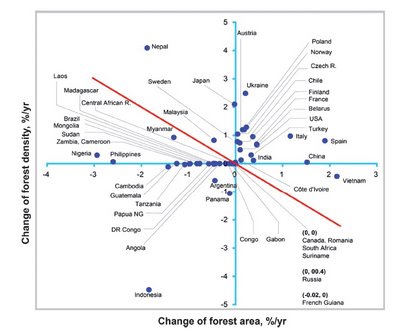
There is a spot of bright news on the horizon. A recent report put out by the US National Academy of Sciences mentions that forests are actually being maintained in many parts of the world, if not actually increasing. In the last 15 years, the United States and China have shown the greatest gain in forest coverage. Even moreso, it shows a general trend of countries around the world of transitioning to reforestation rather than deforestation.
Below is a picture from the article. The red line shows a neutral area+density forest volume; countries above that line are gaining forest volume and mass; those below are losing it.
This is definitely positive news. However, i would counsel that there remains an issue with logging large, old-growth forest. These venerable trees form the backbone of an ecosystem; they harbor the most water, possess the greatest surface area for CO2 reductions, and anchor the soil the greatest against erosion and other degredation. These trees still need protection from deforestation.
But, allow yourself a smile at this good news, which is so rare in the arena of environmental protection.
Here is an article at Planet Ark about the report.
Here is the report in its entirety from PNAS.
Below is a picture from the article. The red line shows a neutral area+density forest volume; countries above that line are gaining forest volume and mass; those below are losing it.

This is definitely positive news. However, i would counsel that there remains an issue with logging large, old-growth forest. These venerable trees form the backbone of an ecosystem; they harbor the most water, possess the greatest surface area for CO2 reductions, and anchor the soil the greatest against erosion and other degredation. These trees still need protection from deforestation.
But, allow yourself a smile at this good news, which is so rare in the arena of environmental protection.
Here is an article at Planet Ark about the report.
Here is the report in its entirety from PNAS.
Monday, November 13, 2006
UNSF
There has been a lot of discussion about the ineffectiveness of the UN. That is the primary criticism coming from conservatives, that the UN talks and talks and makes resolutions and does not have the backbone to enforce them, instead relying on member states to provide the muscle for any operation the UN has resolved is necessary. There is an easy way to get around that. Introducing: The United Nations Strike Force.
The United Nations Strike Force (UNSF) would be responsible for the "first response" of any UN legislation that requires military action. In such areas as Darfur, Bosnia, and anywhere around the world where the UN has decided it necessary to step in and take a side for world peace and prosperity. It is a small, elite military unit (comparable to the Navy Seals, Army Rangers, Green Barets, etc.) that operate under the expressed juristiction of the UN. It is a small but well-equiped unit, with all the latest in warfare technology. A hybrid force of aerial, sea-based, and land forces that could work together in a fast-paced, high risk environment. The actual size of the unit would depend on the mission involved and the particulars of the creation of the unit by the UN, but I would imagine somewhere on the order of 10,000-20,000. Obviously some parts of a military would have to be foregone (aircraft carriers, for instance, require too many personnel to be operated effectively), but they could be surmounted by innovations in technology and planning (using the Joint Strike Fighter would enable vertical take-offs, putting these jets on smaller ships without the usual crew needed on a carrier).
The personnel involved would come from the member nations' militaries. However, they would be on a multi-year loan from their country to the UN. While they are serving the UN, they are UN Soldiers, not American/Canadian/French/etc. soldiers helping with a UN effort. Their loyalties lie with protecting the UN Charter and the decisions of the Security Council. They are UN Soldiers while they are there. The council would, of course, do their best to avoid sending troops to areas of the world where there would be a conflict of interest. So, any Muslim troops would not have been forced to fight against Saddam Hussein (but if they wanted to, no problem).
This force would not be the size of a regular standing army, and once they had cleared the way, removed major obstacles, then regular, member-sponsored peacekeepers would take their place. This would be a dangerous position to hold, as the soldiers would be working in some very hostile environments against a myriad of enemies. But they would be defending global peace, freedom, and rights, and that certainly is a just cause to be working towards.
Perhaps the most important part of this is that it would force countries to think twice before defying the UN's resolutions in the future. No longer could they scoff at sanctions, demands for cessation of activities, requests for entry to genocidal areas. For the UN would have a powerful muscle to strike with, and force them to capitulate to the UN. Used correctly, this could be a good tool to wrangle with despots the world over, who know that they can blow off the UN and not have to face serious consequences. That would change, and we could work quickly and effectively towards limiting conflict and establishing peace across the globe.
Wednesday, November 08, 2006
Midterms for all
It is quite amazing how these elections can reverberate around the world, and it reinforces how important American politics and policies are to the rest of the global population. With the take-back of the House (and perhaps the Senate... still seeing how a couple races end), the Democrats have offered a lot of hope to a great number of people.
In the Middle East, where in pro-Western Jordan, a newspaper editor said many Arabs "are delighted that the American voters have at least disassociated themselves from [President Bush's] dangerous policies."
At the United Nations Environmental Program (UNEP), some of the participants at a climate conference pointed to the midterm elections as a sign that positive changes might come about in the U.S.'s environmental attitude. "President Bush still has two more years in office so it's very unlikely that the U.S. negotiating posture will change," said Alden Meyer of the Union of Concerned Scientists. He added that the fact that Democrats, many of whom support emissions caps, took control of the House means climate and energy issues will be prominent in the 2008 presidential campaign.
It also has highlighted the need for a strong bipartisan (damn I hate that word; it just sounds like politician-speak for elections) work to keep the influence of America strong. Some around the globe worry that a rift in the power scheme of our legislature, coupled with a lame-duck second-term president might stall progress on international issues by weakening much-needed American influence. In other parts of the world:
"We hope American foreign policy will change and that living conditions in Iraq will improve," said 48-year-old engineer Suheil Jabar, a Shiite Muslim in Baghdad.
In Copenhagen, Denmark, 35-year-old Jens Langfeldt said he did not know much about the midterm elections but was opposed to Bush's values. He referred to the president as "that cowboy."
In Sri Lanka, some said they hoped the rebuke would force Bush to abandon a unilateral approach to global issues.
Only time will tell if the Dems can capitalize on their success and translate it into real domestic and international policy development. They have been given a chance to prove that they are different, along with a time-line: 2 years to show something, or forget about the Presidency in 2008. Time to get moving.
apologize for the delay
Hey everyone, I'm sorry for the lengthy delay in new postings. My personal life has taken some complicated turns, with the possibility of a return to academic life via graduate school, a lot of time has been spent prepping applications and the like. But never fear, I will do my best to keep on with this site, as there are tons of ideas that have been floating through my head and I want to get them down.
~~Josh
~~Josh
Thursday, September 07, 2006
Green CEOs
Steven Milloy of foxnews.com wants you to believe that being a CEO in favor of green business is bad for business. In his most recent column, he gives three "examples" of how CEOs of major companies, by trying to move in a greener route, have sparked a decline in their own company's future value. He picks the specious cases of Ford, British Petroleum, and the upcoming "crisis" in General Electric. However, if you read what he has to write, he is simply not making any sense.
Ford's choice of CEO may have not been the wisest choice in the world, but the 5-year reign of Bill Ford did not have the disasterous effect that Millor wants you to believe. His reasoning is that, since Bill actively sought to turn his company down a greener road, the 2/3 loss of stock value that the company has endured is his fault. Instead, it was a company's reliance on trucks and SUVS - which consume huge amounts of gas - that dragged them down, and their unwillingness to change. Look at Ford's compatriot, General Motors. A company similarly laden down with the same burdens, has not had an environmentalist at the helm but still has managed to shed the majority of its value. In stark contrast, Toyota got on board the green vehicle bus very early, and is currently reaping in the benefits from it (note: here in California the waiting list for a Prius was, at one point, 7 months... how many cars would you willingly pay for in advance, and then wait 7 months for it to be delivered? not many). Honda is also there, and they have a good corner on the solar panel manufacturring market to bolster them up. So it was not these last 5 years that have doomed Ford, it has been decades of negligence and unwillingness to act or recognize changes down the road.
Negligence reminds me of Milloy's comments about BP's CEO Lord John Browne. Milloy states that, while Browne is trying to turn a new leaf in the company's long and sometimes turbid history, he has neglected "core business needs and has given the company a black-eye." What is evidence for this accusation? "A March 2005 explosion at BP’s Texas City, Texas, refinery complex killed 15 workers and injured many more. Poor maintenance at BP’s Alaskan oil pipeline caused the largest-ever oil spill on the North Slope in March 2006. A BP oil rig damaged by Hurricane Katrina still leaks one year later." Now the pipeline corrosion is a condition that builds up over years, if not decades, making recent decisions by the CEO hardly relevant. Even more important, the pipeline is soon to be back online,by BP's estimates. Explosions and hurricanes, while unfortunate, happen, at great cost to lives, money, and the environment. But these are pitfalls in any company, and freak acts like those do not necessarily reflect upon the CEO in question. Instad, trying to push BP into a new generation of companies working with alternative fuels, helping California's governor work with a new global-warming initiative, and work with partners like Greenpeace are constructive steps that more companies should take.
The truth of the matter is that green companies are starting to turn a profit, and make a lot of sense. Forbes magazine opines, "Evidence is mounting that what is good for the environment is also good for the price of a company's stock. Contrary to the widely accepted belief that environmental regulations are a drain on profitability, research demonstrates that being environmentally effective can add value to a company, and potentially benefit its shareholders. By taking advantage of environmental opportunities, companies can gain a competitive advantage over their peers through cost reductions, quality improvements, increased profitability and access to new and growing markets. Environmentally responsible companies also have less risk of environmental liability, which could have a major impact on future stock prices." And that was two years ago, before a lot of green businesses that exist today are even in place.
According to the Carbon Disclosure Project, "More than 70 percent of the world's largest 500 companies (FT 500) are now addressing climate change in their corporate reporting, according to the Carbon Disclosure Project. In addition, 90 percent of those companies flagged climate change as posing commercial risks and/or opportunities to their business." Toyota's hybrid cars have certainly been a boost for that company, as mentioned above. Portfolio 21's top 10 green companies for 2005 returned anywhere from 52% to 120%, hardly shabby growth by any metric.
Milloy's comments are not merely obtuse, but blatantly misleading. He chooses such abominable examples to base his case around that it could be hardly considered journalism. As I have shown, most of his accusations are not the result of one man's actions, as those take longer to matriculate in a large corporate atmosphere. Instead, CEOs who think green and act green should be encouraged to continue what they are doing, for it will benefit their shareholders, their customers, and society in general. Milloy should stop pandering and slandering and write about something about which he actually understands.
Wednesday, September 06, 2006
The Rag Rant
How destructive, the petty diversions of our life. Americans are being destroyed by consumption, and not the Violetta type. Our TV watching is approaching a third of our lives (up to an average of 8.2 hours/day/household, according to Time Magazine), and we continually fill our waking existence with intellectual tripe. Celebrity marriages, star gossip, fashion obsession. Are these items that will help you improve your lives? Will knowing that Tom Cruise and Katie Holmes' baby looks like (even getting a glimpse of her bronzed shit) help you in your own marriage? Improve your work life? Become healthier, wiser, a more active citizen in this country?
No, they will not. Instead, these trivialities are distractions from your life. While entertainment is certainly not looked down upon, to spend hours of television programming, newspaper print space, and vast amounts of time in your own life ingesting, memorizing, prioritizing these tidbits is unconscionable. Why do we care? What relevance does this have to our own selves? Nada. Rather, we use these pieces of pop culture to remove us from our own reality, to escape from the difficult thoughts that lie with our own lives and the decisions that need to be made regarding our future. It is easier to think about Brangelina than about the impeding death of Social Security; Jessica Simpson's new fling is more fun to contemplate than trade deficits or poor education or the illegal immigrant debacle.
Hollywood will not be denied; and in their cunning they have isolated ourselves from our own rational brains, fractionated off a portion of it in order to serve no particular useful purpose. And we have swallowed, as a society, hook, line, and sinker. We buy trashy magazines, watch the tabloid shows, participate in useless water-cooler tirades and gossip trading, rather than trying to use those neurons, use that time, use those contacts to try and actually do something constructive. Heaven forbid that we attempt to improve our lives, indulge in our own artistic side, try to construct a more perfect union. We face serious issues, and to sit around diddling our lives away on such star-studded bullshit is beyond me, and should be beyond us. Put down People. It is not about you, it is not for you, it exists merely to waste your money and time.
Wednesday, August 23, 2006
And while you’re at it, you might want to look under your bed too…
There is nothing worse than playing boogey-man politics. And, unfortunately, September 11, 2001 gave this administration the greatest boogey-man imaginable: secretive, exotic, filled with unmitigated hate, powerful, able to strike and disappear in a second, only to reappear months or years later. With the joint attacks on that day, the united states launched its “war on terrorism” to safeguard America in this vast, chaotic world we live in. And if you listen to this administration, they would trumpet the fact that there has been so significant repeat of the terrorist acts since 9/11. However, they fail to mention that in the 200 years before that infamous date there had also been no significant terrorist attack. Quite a track record they’re developing.
But they do not want you to know that. They do not want you to focus on where your jobs are going, why your children are not as educated as Chinese children, why our environment is degrading, why we’re in debt, fat, overworked and underpaid. No, no, no, those are questions for another time. BUT LOOK!! The evil terrorists are at it again! You must vote for us because only we can keep you safe! And if we are not super, 1000% vigilant (damn fuzzy math), then they will get us. We need to “fight them there, or we fight them in the supermarkets and streets here,” according to Rep. Curt Weldon (R-PA) on CNN.
This is not to discount the fact that there are terrorists out there, bad ones (speaking of the war on terror, how is Bin Laden doing?). But they are hyperboleed up to the highest level as if our very next breath is tainted with their chemicals, their microbes, unless our valiant Republican party is at the helm to stop them.
Every time they are worried that they will lose an election (and you know who I mean when I say “they”), they pull out their supposed trump card of terrorism. Ratcheting it up to scare us and make our hands shake at the ballot box, clicking “Republican so-and-so” just so we feel reassured that we’re safe again, with them in power. Puhhhlease. I can only hope that we are not as easily deluded as they think we are. We outgrew monsters in our closets when we were 8 years old.
Monday, August 14, 2006
I cannot believe...
It never ceases to amaze me how people can behave like Neanderthals sometimes. This story out of Maryland demonstrates that principle clearly. A man, deciding to protest a Muslim candidate to the state’s House of Delegates, has staged a one-man “protest” outside of the candidate’s home, wearing a shirt that says, “Islam Sucks.” His reasoning for his protest? “I had heard that Muslims were generally intolerant of views other than their own, and so I thought I would put it to the test.” By insulting the person? By insulting his personal religion? Who would not be tempted to strike back, talk back, against such statements? The man has been warned of being prosecuted for trespassing. However, if this man were to happen to have a sign saying “Judaism Sucks” in front of a Jewish candidate’s house, you had better believe he’d be slapped with more than just trespassing. Hate crimes, bigotry, all sorts of labels would be associated with him. But since it is a Muslim candidate, then he’s only trespassing. To his credit, the candidate has not dignified the man with a response, saying there is nothing constructive about his dialogue. What true words!
The double-standard that is appearing, and the whole culture which resides behind this single man’s attitude is sickening. What sweeping ignorance has paved his path to arrive at this candidate’s front door. Such wide, blunt brushes he paints other cultures with. We paint cultures with. I thought as a nation we had progressed beyond such thing. We should be ashamed that this happens here in our country of the free. And do not bring to me the argument that it is free speech. The man himself defends his actions, saying they are not hateful, merely expressing an opinion. But the cultural connotations of his words transcend mere opinions into the realm of hate-driven expressions.
If I had chose a person I’d want as a neighbor, a fellow citizen, my decision would rest solely with the Muslim, rather than allow such a blunt-minded hypocrite to share my country with. This man repulses me to my core.
Friday, August 04, 2006
Adieu, Les Pommes Frites de la Liberté – Et Bonjour aux Pommes Frites “Françaises”
It was with little fanfare recently that the “Freedom Fries” at the cafeteria of Congress reverted to their more familiar name, “French Fries.” This marked the end of a curious era for the lovable potatoes, and settled a good amount of the identity problems they had been going through.
In all seriousness though, the whole Freedom/French Fry thing might be a broader signal of the change of politics we can only hope is coming to our nation’s capital. The changing of the name was ridiculous at best, giving many a chance to – rather than poke fun at the French – ridicule our Congress, who should have better things to do than to try to influence what people call their deep-fried potatoes. It was a rash act, one that has now been rectified.
But rash acts were a symbol of this administration for a long time, full of bravado and brash statements, and in the end very little content. The “war” in Afghanistan, which is still plodding along amongst rumors of increased Taliban activities, as well as enormously large opium crops (didn’t we wipe that out when we “won” the war in 2001/2002?) is only one example. The total list is beyond this server’s capacity to upload.
Along with these positions goes with the unilateral feeling of the administration, lampooning allies when they weren’t totally with us, while forging relationships with foreign powers we were soon to try and reverse (gee, that doesn’t sound familiar, does it? See: Taliban in Afghanistan, Saddam Hussein in Iraq, and Osama bin Laden for more information). So, haraunge the French when they opposed our war in Iraq, but now we realize they might be crucial to any sort of peace talk in Lebanon, not to mention the Darfur region.
So perhaps we are seeing a more multi-lateral form of politics emerging, a spirit of contrition and willingness to work with others, rather than just stick it alone. That would be a big change in policy from our “decider” President. Talk about flip-flopping on issues. Fries are just the beginning.
Wednesday, July 26, 2006
Not a Passing Mark
The debate over the California exit exams continues to rage, now making its way up the court levels to another appeal. At the heart of the matter is whether or not 20,000 students who flunked the exam, but otherwise fulfilled graduation requirements, should be awarded diplomas. The plaintiffs say the case is unfair, and not all students had an equal chance at learning the material necessary to pass.
This is definitely a sticky subject, as it touches on some fundamental problems in our educational system, especially in good ole California. However, the thought of exams to help assess our children’s academic acuity is appealing to me, especially as there are gross differences in the “grades” that different schools hand out. As such, and as much as people will claim there are biases and differences, I think the results should stand and the people should fail.
These tests have been coming for years now. There has been ample time for schools, and students, to prepare for them. For several years these tests were taken, but not mandatory for graduation. This is the first year it is required to graduate. The students knew it was coming; this was not a last-minute pop quiz given to them. If they felt they were behind, and their school wasn’t cutting it, they should have sought help elsewhere. That is what students have been doing for eons – you need help, you find a tutor.
Secondly, this is a state curriculum mandate. The board has said you need to know xyz to be considered graduated from high school. Yes there are inequalities associated with it. That happens with all things, and it is an indication for the schools to improve. You could make a similar argument with college acceptances. All students are not equally prepared to apply to Harvard, and they don’t have the same chances to get in. Does this mean therefore that all students should be accepted to Harvard carte blanche? No. While schools should be prepared to improve, to offer more services to their students, to better prepare and educate them, the fact is that there is a set of standards now set before the students, and they did not pass the test. Literally.
And they should hold themselves accountable for that in some part. That may sound harsh, but it is their responsibility to pass the test, just like it is ultimately their responsibility to go to school, apply to college, get a job, etc. If they don’t have what it takes, it is not the fault of the test to point out their deficiencies. It is not 100% fair, and it should be remedied for the future, but these students need to realize they don’t have what it takes. We need qualified students moving into our businesses, our government, and our colleges. It is the quality of this education that keeps us going as a country, and this is a dire sign we need to improve. But for the future of American sciences, economics, and our status as an innovative society, they should fail.
Friday, July 21, 2006
Divestment Rewards?
There is a reason why there is antitrust legislation on the books of our nation’s laws. Many decades ago, as the industrial revolution was peaking, there was a lot of wealth and power concentrated in few people. This is the era of huge fortunes and names like Rockefeller, Getty, Carnegie, and Morgan. It was creating a monopoly of power in key United States industries, like steel, oil, transportation, and communications. So the government, in a magnanimous sign of socialism, enacted these laws in order to help keep the American dream alive for the majority of the people. Some people have claimed that it merely puts capital into inefficient hands, thus hampering the progress of an industrial nation, but I would argue that by lifting up the bottom of the economic sectors, we can only better ourselves in the long run. That is still up to debate.
Fast forward nearly 70 years, to the 1984 divestment of AT&T, aka Ma Bell. At the order of the government seven spin-offs were generated to handle local telephone service. They included Pacific Bell, Bellsouth, Bell Atlantic, NYNEX, USWest, Ameritech, and Southwestern Bell. AT&T held on to its long-distance services, which were immediately faced with competition from companies like Sprint and MCI. Good for competition, right? But the wheels of capitalism move in much more subtle ways. Over the years, the “baby bells” have been slowly merging, re-grouping, enlarging their holdings. In the late 1990s, Southwest Bell purchases Pacific Telesis (PacBell), Southern New England Telecommunications and then Ameritech. Under the name SBC, the group now consists of 3 of the original 7 spin-offs. Then SBC joins cellular plans with BellSouth in a 60/40 split. By 2004 it has merged with AT&T Wireless into one unit. It is not done yet. In 2005, SBC reaches an agreement to merge with AT&T, its former parent company. It is approved, and rebrands to AT&T for unity sake.
And now we come to the present. It was announced today that BellSouth shareholders ok a merger with AT&T (the one-time SBC). Should the SEC approve the merger, this would mean that the wireless company would finally come home to roost under one management structure. And it would mean that 4 of the 7 baby bells have regrouped with the parent company and added the major wireless network to its holdings. All in under 24 years. What was the original divestment for, if it was only to buy two decades of “competition” before allowing them to consolidate once more? Talk about inefficiency in economics.
Should the merger go through, AT&T (blue) would be merged with BellSouth (yellow). Image courtesy of wikipedia.org
Subscribe to:
Posts (Atom)